The Fundamentals of Sanatana Dharma: Part V

In this section we deepen our understanding of Sanatana Dharma by looking at some of its fundamental ideas and distinctive characteristics. Let us begin with an important excerpt from Sri Aurobindo’s famous Uttarpara speech, delivered on May 30, 1909. This was his first speech after acquittal from Alipore jail, when for the first time spoke publicly of his Yoga and his spiritual experiences. He reminded his fellow countrymen of the work that India must do for humanity.

“When…it is said that India shall rise, it is the Sanatana Dharma that shall rise. When it is said that India shall be great, it is the Sanatana Dharma that shall be great. When it is said that India shall expand and extend herself, it is the Sanatana Dharma that shall expand and extend itself over the world. It is for the dharma and by the dharma that India exists.” (CWSA, Vol. 8, p. 10, emphasis added)

In this speech he also clearly explained what is meant by the Sanatana Dharma, the eternal dharma. He emphasised that only that religion which embraces all others, which embraces in its compass all the possible means by which one can approach the Divine, can be truly universal, truly eternal.

“But what is the Hindu religion? What is this religion which we call Sanatana, eternal? It is the Hindu religion only because the Hindu nation has kept it, because in this peninsula it grew up in the seclusion of the sea and the Himalayas, because in this sacred and ancient land it was given as a charge to the Aryan race to preserve through the ages. But it is not circumscribed by the confines of a single country, it does not belong peculiarly and for ever to a bounded part of the world. That which we call the Hindu religion is really the eternal religion, because it is the universal religion which embraces all others. If a religion is not universal, it cannot be eternal. A narrow religion, a sectarian religion, an exclusive religion can live only for a limited time and a limited purpose. This is the one religion that can triumph over materialism by including and anticipating the discoveries of science and the speculations of philosophy. It is the one religion which impresses on mankind the closeness of God to us and embraces in its compass all the possible means by which man can approach God. It is the one religion which insists every moment on the truth which all religions acknowledge, that He is in all men and all things and that in Him we move and have our being. It is the one religion which enables us not only to understand and believe this truth but to realise it with every part of our being. It is the one religion which shows the world what the world is, that it is the lila of Vasudeva. It is the one religion which shows us how we can best play our part in that lila, its subtlest laws and its noblest rules. It is the one religion which does not separate life in any smallest detail from religion, which knows what immortality is and has utterly removed from us the reality of death.” (ibid, pp. 11-12)

The Foundation

The religio-spiritual culture which presently goes by the name of Hinduism is essentially an immense, many-sided and many-staged open framework for a spiritual selfbuilding and self-finding by the individual. Sri Aurobindo lists three fundamental or basic ideas which form the foundation of Sanatana Dharma or Hinduism.

1. The idea of the One Existence of the Veda to whom sages give different names, the One without a second of the Upanishads who is all that is and beyond all that is, the Permanent of the Buddhists, the Absolute of the Illusionists, the supreme God or Purusha of the Theists who holds in his power the soul and Nature,— in a word the Eternal, the Infinite.

• This first common foundation can be and is expressed in an endless variety of formulas by the human intelligence. A spiritual seeker’s effort is to discover and closely approach and enter into whatever kind or degree of unity with this Permanent, this Infinite, this Eternal.

2. Its second basic idea is the manifold way of man’s approach to the Eternal and Infinite. In each finite we can discover and through all things as his forms and symbols we can approach the Infinite; all cosmic powers are manifestations, all forces are forces of the One. The gods behind the workings of Nature are to be seen and adored as powers, names and personalities of the one Godhead.

• Indian religious mind understood that man approaches God at first according to his psychological nature and his capacity for deeper experience, svabhava, adhikāra. The level of Truth, the plane of consciousness he can reach is determined by his inner evolutionary stage. This is why there is a need for a variety of religious forms, symbols and outer structures. But these are not imaginary structures, inventions of priests or poets, but truths of a supraphysical existence intermediate between the consciousness of the physical world and the ineffable super conscience of the Absolute.

3. The third idea at the base of Indian religion is the most dynamic for the inner spiritual life. “While the Supreme or the Divine can be approached through a universal consciousness and by piercing through all inner and outer Nature, That or He can be met by each individual soul in itself, in its own spiritual part, because there is something in it that is intimately one or at least intimately related with the one divine Existence. The essence of Indian religion is to aim at so growing and so living that we can grow out of the Ignorance which veils this self-knowledge from our mind and life and become aware of the Divinity within us.” (CWSA, Vol. 20, p. 195)

The Need for Outer Forms and Ceremonies

An objective and thorough study of the nature of religion demands that we must ask the question if the diverse outer forms – rituals, ceremonies, creeds and systems etc. fulfill any psychological need of human beings. In our ‘Reason-inspired’ zeal to get to the spiritual essence of a religion we must not consider these outer forms altogether negligible or unworthy or unnecessary.

Sri Aurobindo helps us understand deeply as to why these are in fact important aids on the journey to an inner spiritual seeking. The outer forms, systems, ceremonies and rituals are needed because a human being is a complex being with many parts – physical, emotional, mental, and their various interactive ranges of being. All these various parts have to be exalted and raised to their highest potential before they can feel the touch of the deeper spirit, before they can directly feel the spirit and obey its law.

The various outer forms of religion help meet the needs of these various parts of the human being:

1. An intellectual formula is often needed by the thinking and reasoning mind of our being.

2. A form or ceremony is needed by the aesthetic temperament or other parts of the infrarational parts of our being.

3. A set moral code is necessary for man’s vital nature in their turn towards the inner life.

But, as Sri Aurobindo, cautions, these things are aids and supports, not the essence of a religion. They are necessary and therefore must be offered to and used by the seekers, but they must not be imposed on anyone by a forced and inflexible domination. Tolerance and free permission of variation is the first rule which must be observed.

A true seeker of spirit must also remember that these outer forms including ceremonies, rituals, intellectual systems etc. belong to the rational and infrarational parts of the religion, and that is why they can be nothing more. And, if we blindly insist upon these outer forms too much, these may even hamper our inner seeking for that which is beyond rationality, the suprarational light of truth.

For a true seeker, the spiritual essence of religion is the one, true, real thing supremely needful, the thing to which he must always hold on to and subordinate to it every other element or motive. “The deepest heart, the inmost essence of religion, apart from its outward machinery of creed, cult, ceremony and symbol, is the search for God and the finding of God.” (CWSA, Vol. 25, p. 131)

Scaffolding of the Externals

Why do we see such a strong emphasis on the external forms of religious practices in Hinduism and other Indian religions such as Jainism and Buddhism? Let us explore this question some more.

Indian spiritual thought recognizes that the highest spiritual seeking indeed moves in a free and wide air far above that lower stage of seeking which is governed by religious form and dogma. The highest and deepest aspiration for the Divine does not easily bear the limitations imposed by any outer religious form. And, even when it admits, it transcends them; it lives in an experience which to the formal religious mind is unintelligible.

But, as Sri Aurobindo explains, the vast majority of human beings do not arrive immediately at that highest inner elevation. And if it were demanded from them at once, they would never arrive there.

At first [an individual] needs lower supports and stages of ascent; he asks for some scaffolding of dogma, worship, image, sign, form, symbol, some indulgence and permission of mixed half-natural motive on which he can stand while he builds up in him the temple of the spirit. Only when the temple is completed, can the supports be removed, the scaffolding disappear. The religious culture which now goes by the name of Hinduism not only fulfilled this purpose, but, unlike certain credal religions, it knew its purpose.” (CWSA, Vol. 20, p. 179)

This image of the external forms of a religion being the scaffolding necessary for a certain period of time while a temple of the spirit is being slowly built within the individual’s heart and soul is a very powerful one. It also brings greatest clarity to the sceptic mind which questions the relevance of the outer religious forms, rituals, ceremonies and practices.

At the same time, it is a common failing of the human nature that it often tends to put too much stress on externals and only the externals. This has been the case in periods of Indian religious history as well. But then again, as Sri Aurobindo reminds us, India has also seen a constant stream of saints and religious thinkers and the teachings of illuminated sannyasins (“messengers of the spirit” as he calls them), who have kept the religious life a living reality and resisted the deadening weight of form and ceremony and ritual.

And the still more significant fact remains that there has never been wanting either a happy readiness in the common mind to listen to the message. The ordinary materialised souls, the external minds are the majority in India as everywhere. …But at least the people of India, even the “ignorant masses” have this distinction that they are by centuries of training nearer to the inner realities, are divided from them by a less thick veil of the universal ignorance and are more easily led back to a vital glimpse of God and Spirit, self and eternity than the mass of men or even the cultured elite anywhere else. Where else could the lofty, austere and difficult teaching of a Buddha have seized so rapidly on the popular mind? Where else could the songs of a Tukaram, a Ramprasad, a Kabir, the Sikh gurus and the chants of the Tamil saints with their fervid devotion but also their profound spiritual thinking have found so speedy an echo and formed a popular religious literature? This strong permeation or close nearness of the spiritual turn, this readiness of the mind of a whole nation to turn to the highest realities is the sign and fruit of an age-long, a real and a still living and supremely spiritual culture.” (CWSA, Vol. 20, p. 186)

Thus, we see that what may seem to an overly rational-modernised mind as a merely “religious” culture is in reality an outer expression of a deep spiritual basis that forms the essential foundation of the culture and expresses itself externally through religious forms, ceremonies, rituals and other means.

Of One and Many

Indian landscape is filled with temples and images of numerous gods and goddesses, millions of devotees worship them, recite mantras and prayers and seek their blessings. The number of devatas in India may range from 33 to 33 crores, and the Indian mind has no objection to adding, if need be, to this mighty multitude. Like all other religious forms that outwardly express the inner spiritual truth, there is much profound truth or meaning behind such worship of gods. As Sri Aurobindo explains:

The gods of this worship are, as every Indian knows, potent names, divine forms, dynamic personalities, living aspects of the one Infinite. Each Godhead is a form or derivation or dependent power of the supreme Trinity, each Goddess a form of the universal Energy, Conscious-Force or Shakti.” (CWSA, Vol. 20, pp. 146-147)

Hinduism founded itself on the conception of a timeless, nameless and formless Supreme, but unlike the Abrahamic monotheisms, it did not feel the need to deny or abolish all intermediary forms and names and powers and personalities of the Eternal and Infinite.

Sri Aurobindo explains that Indian polytheism is not the popular polytheism of ancient Europe, “for here the worshipper of many gods still knows that all his divinities are forms, names, personalities and powers of the One; his gods proceed from the one Purusha, his goddesses are energies of the one divine Force.” (CWSA, Vol. 20, p. 192). And because the one Godhead is worshipped as the All, for all in the universe is He or made out of His Being or His nature, it does not mean that Indian religion is pantheism, because the Indian religious mind recognises that beyond this universality exists the supracosmic Eternal.

It is important to note that even the later religious forms which most felt the impress of the Islamic idea, such as Sikhism which emphasizes the worship of the timeless One, Akala, still draws away from the limitations of the Western or Semitic monotheism, and base themselves on the fathomless truth of Vedanta. Furthermore, the divine Personality of God and his human relations with man which are strongly stressed by the religious systems of Vaishnavism and Shaivism as part of their worship practices are not built on the notion of a limited magnified-human personal God of the Semitic religions.

“For in each finite we can discover and through all things as his forms and symbols we can approach the Infinite; all cosmic powers are manifestations, all forces are forces of the One. The gods behind the workings of Nature are to be seen and adored as powers, names and personalities of the one Godhead. An infinite Conscious-Force, executive Energy, Will or Law, Maya, Prakriti, Shakti or Karma, is behind all happenings, whether to us they seem good or bad, acceptable or inacceptable, fortunate or adverse. The Infinite creates and is Brahma; it preserves and is Vishnu; it destroys or takes to itself and is Rudra or Shiva. The supreme Energy beneficent in upholding and protection is or else formulates itself as the Mother of the worlds, Luxmi or Durga. Or beneficent even in the mask of destruction, it is Chandi or it is Kali, the dark Mother. The One Godhead manifests himself in the form of his qualities in various names and godheads. The God of divine love of the Vaishnava, the God of divine power of the Shakta appear as two different godheads; but in truth they are the one infinite Deity in different figures. One may approach the Supreme through any of these names and forms, with knowledge or in ignorance; for through them and beyond them we can proceed at last to the supreme experience.” (Sri Aurobindo, CWSA, Vol 20, pp. 194-195)

To Be Continued..

Beloo Mehra is a student of Sri Aurobindo and writes on topics related to education, culture and society. Many years of experience in the field of education and research led her to the discovery that the central thing is to constantly un school oneself and become a freer and truer learner. She enjoys playing several roles Life offers a woman – with a hope to learn from all that happens and doesn’t happen, and with a wish to gradually become free of those roles because only then the possibility of the birth of true actor (or the non-actor) within exists

Dharma or Religion? : Part IV

Having understood the Indian outlook on Religion and the fundamental characteristics of Indian religio-spiritual culture, let us now explore an important question – does the word “religion” as understood in the most ordinary sense of organised religion really make sense in the Indian cultural context, or should we invoke the uniquely Indian word “dharma” to speak of the spiritual nature of Indian culture? Let us understand what is dharma.

Dharma is often mistranslated as religion. But dharma is not same as religion, unless we really understand the word religion in the sense as described in earlier parts of this series – that is, as per the Indian integral outlook on life and human development. This is important to understand because much of the socio-political-cultural conflicts that we see in present-day India arise from this wrong understanding and false interpretation.

If the Infinite or seeking for the Infinite is the major chord of the Indian culture, the idea of the dharma, says Sri Aurobindo, is only second to it. Dharma essentially is the foundation of life, says Sri Aurobindo, only next to the spirit.

Dharma, as Sri Aurobindo summarises perfectly, is that which we hold to and also that which holds together our inner and outer activities. (The word Dharma is derived from the root ‘dhr’ which means ‘to hold’.) Let us read a bit more how Sri Aurobindo explains dharma:

In its primary sense it [dharma] means a fundamental law of our nature which secretly conditions all our activities, and in this sense each being, type, species, individual, group has its own dharma. Secondly, there is the divine nature which has to develop and manifest in us, and in this sense dharma is the law of the inner workings by which that grows in our being. Thirdly, there is the law by which we govern our outgoing thought and action and our relations with each other so as to help best both our own growth and that of the human race towards the divine ideal….
Dharma is generally spoken of as something eternal and unchanging, and so it is in the fundamental principle, in the ideal, but in its forms it is continually changing and evolving, because man does not already possess the ideal or live in it, but aspires more or less perfectly towards it, is growing towards its knowledge and practice. And in this growth Dharma is all that helps us to grow into the divine purity, largeness, light, freedom, power, strength, joy, love, good, unity, beauty, and against it stands its shadow and denial, all that resists its growth and has not undergone its law, all that has not yielded up and does not will to yield up its secret of divine values, but presents a front of perversion and contradiction, of impurity, narrowness, bondage, darkness, weakness, vileness, discord and suffering and division, and the hideous and the crude, all that man has to leave behind in his progress. This is the adharma, not-dharma, which strives with and seeks to overcome the dharma, to draw backward and downward, the reactionary force which makes for evil, ignorance and darkness.” (CWSA, Vol. 19, p. 171173)

Dharma, a Seeking for Right Living

The ancient Indian seers and sages knew very well about the infinitely diverse and complex human nature which comes into play as human beings pursue the different goals of life through different stages or phases of life. So, they came up with the ideal of dharma which would sustain and hold together all this diversity and complexity. The concept of dharma covered basically all natures, all aspects of life, all situations and stages of life, and even allowed for maximum freedom, continuity and greatest possibility of contextualization, adaptation and adjustment.

We find that there is an individual dharma (it varies from role to role – dharma of a son/daughter, wife/husband, mother/father, etc.), group-dharma (dharma of an organization like a guild of craftsmen or a regiment of soldiers or a gurukulam/educational institution or a guru’s ashram, etc.) the kula-dharma (dharma of an extended family lineage), jati-dharma (dharma of a collective of lineages), yuga dharma (dharma appropriate for a yuga or time – which means dharma changes from time to time — what is appropriate today may not be relevant tomorrow), dharma of a king, a leader, dharma of a soldier, an educator, a craftsman, a student, etc. Then we also find dharma varying for different communities, dharma depending upon the stage of life one is going through (dharma of a householder is different from dharma of a social recluse/ascetic or from dharma of a student).

The society was meant to be organized around this ideal of Dharma. The idea was that if people truly acted and lived according to the truth of their dharma they would be able to live harmoniously with others and eventually work towards their own self-fulfillment in life which eventually takes them closer and closer to discovering their true nature – swabhava and discovering their swadharma – the deeper purpose of their life (discovering and living in one’s true self/soul). This gradual progress in one’s life and living by the dharma appropriate to age, station, and place in life and society, helped one grow inwardly and spiritually.

The idea of dharma and the important way in which it is different from the more rigid and mechanical “Law” or imposed by an external authority are deeply ingrained in Indian cultural psyche. Of course, there has also been misapplication of this ideal. Dharma has been used as a way to ensure stability and continuity of the society and at the same time in some cases dharma has also been responsible for stagnation of the society by restricting individual freedom and free expression and by pushing people ‘back in their place’ if they tried to transcend their so-called dharma.

In the Indian view not only every individual but every human activity, even something grossly physical as sex, has its own dharma, its right and natural way of fulfilment according to the truth and law of Nature in that activity. When the activity is performed in a disciplined way according to the canons of its unique dharma then it leads to right enjoyment, success and evolutionary progress for the individual.

To discover the dharma of each activity, and to evolve a system of values, and the art and science for regulating each human activity according to its dharma is one of the major aims of culture. Indian culture insists that even while building a sound socioeconomic and political system to fulfil the artha-kāma needs of the community, the ideals and values of dharma and the cultural life of the community must not be neglected but have to be actively encouraged and promoted so that they cast a refining and restraining influence on the socio-economic life of the community.

In the Indian scheme of purusharthas, the word dharma is generally used in the sense of “duty” or, to be more specific, fulfilment of the social responsibility of the individual through an occupation, which is in consonance with his/her swadharma, true purpose. But the word can be interpreted in a broader sense to include the mental, moral and cultural development of the individual and collective. To put it succinctly, dharma is all that lifts man beyond the essentially animal impulses of his physical and vital being towards his true manhood.

Since man in the present status of his evolution is essentially a mental being, his first major accomplishment must be to fulfil his mental dharma which means to develop fully all the powers, faculties and potentialities of his mind – intellectual, moral and aesthetic – and impose a harmonised control of the higher mental will over his lower physical and vital impulses. This is the true meaning and ideal of culture – to realise our highest Manhood. This is the ideal of dharma in the Indian scheme of the fourfold purusharthas; fulfilment of social responsibility and the realisation of a cultured humanity is the dual aspect of this purushartha.

Once the artha-kāma needs of the community are reasonably assured through a sound socio-economic and political organisation, the governing organ of the community must turn its attention, creative energies and resources more and more to the cultural development of the community.

Dharma in the Bhagavad Gita

Sri Krishna in the Bhagavad Gita asks Arjuna to follow his Kshatriya Dharma and later on he also tells him to abandon all dharmas and go into Lord’s refuge. It is a concept difficult to describe. But Sri Aurobindo has surely given a very comprehensive description of it, as we see in the following excerpts from his work, Essays on the Gita:

1. “Dharma is a word which has an ethical and practical, a natural and philosophical and a religious and spiritual significance, and it may be used in any of these senses exclusive of the others, in a purely ethical, a purely philosophical or a purely religious sense. Ethically it means the law of righteousness, the moral rule of conduct, or in a still more outward and practical significance social and political justice, or even simply the observation of the social law.” (CWSA, Vol. 19, p. 169)

2. “Man is not like the tiger or the fire or the storm; he cannot kill and say as a sufficient justification, “I am acting according to my nature”, and he cannot do it, because he has not the nature and not, therefore, the law of action, svadharma, of the tiger, storm or fire. He has a conscious intelligent will, a buddhi, and to that he must refer his actions. If he does not do so, if he acts blindly according to his impulses and passions, then the law of his being is not rightly worked out, …, he has not acted according to the full measure of his humanity, but even as might the animal.” (p. 221)

3. “Dharma in the spiritual sense is not morality or ethics. Dharma, says the Gita elsewhere, is action governed by the swabhava, the essential law of one’s nature. And this swabhava is at its core the pure quality of the spirit in its inherent power of conscious will and in its characteristic force of action. The desire meant here is therefore the purposeful will of the Divine in us searching for and discovering not the pleasure of the lower Prakriti (Nature), but the Ananda of its own play and selffulfilling; it is the desire of the divine Delight of existence unrolling its own conscious force of action in accordance with the law of the swabhava.” (p. 275)

4. “Dharma in the language of the Gita means the innate law of the being and its works and an action proceeding from and determined by the inner nature, svabhavaniyatam karma. In the lower ignorant consciousness of mind, life and body there are many dharmas, many rules, many standards and laws because there are many varying determinations and types of the mental, vital and physical nature. The immortal Dharma is one; it is that of the highest spiritual divine consciousness and its powers, para prakrtih. It is beyond the three gunas (tamas, rajas, sattwa), and to reach it all these lower dharmas have to be abandoned, sarva-dharman parityajya. Alone in their place the one liberating unifying consciousness and power of the Eternal has to become the infinite source of our action, its mould, determinant and exemplar.” (pp. 405-406)

Once we begin to intellectually grasp the multi-layered meanings of this concept of dharma, we begin to recognize that the English word ‘religion’ does not do justice to any of these meanings.

The word ‘religion’ is perhaps not suitable at all when we speak of the Indian spiritual culture and traditions. Dharma, as we have seen above, is a uniquely Indian idea
which can’t be merely translated as duty, religion, code of conduct, ethical rule, moral law, or other such English language words. It is none of these and yet may have something of these. It transcends all these limiting and limited terms and yet includes some things from each of these. It is individual and universal at the same time. It is fixed and evolving at the same time, it is eternal and yet gradually progressive. It is of a person, and cosmic at the same time. It is an inner guide, which must be discovered individually, and yet must be a part of the larger dharma of the group, the nation, humanity to which one belongs.

It may, therefore, be more accurate to say that the essence of Indian social-cultural ideal is to strive toward being a dharmic society, not a religious society

To Be Continued..

Beloo Mehra is a student of Sri Aurobindo and writes on topics related to education, culture and society. Many years of experience in the field of education and research led her to the discovery that the central thing is to constantly un school oneself and become a freer and truer learner. She enjoys playing several roles Life offers a woman – with a hope to learn from all that happens and doesn’t happen, and with a wish to gradually become free of those roles because only then the possibility of the birth of true actor (or the non-actor) within exists

Distinctive Characteristics of Indian Religion: Part III

“Indian religion cannot be described by any of the definitions known to the occidental intelligence. In its totality it has been a free and tolerant synthesis of all spiritual worship and experience. Observing the one Truth from all its many sides, it shut out none. It gave itself no specific name and bound itself by no limiting distinction. Allowing separative designations for its constituting cults and divisions, it remained itself nameless, formless, universal, infinite, like the Brahman of its agelong seeking. Although strikingly distinguished from other creeds by its traditional scriptures, cults and symbols, it is not in its essential character a credal religion at all but a vast and many-sided, an always unifying and always progressive and self-enlarging system of spiritual culture.” (CWSA, Vol. 20, p. 193)

Based on the discussion so far, here are some distinctive characteristics of Indian Religion, or rather Indian outlook on Religion, as discussed in various writings of Sri Aurobindo, particularly his essays on Indian Culture.

1. All beings are to the Indian mind portions of the Divine, evolving souls, and sure of an eventual release into the spirit.

2. The ancient idea of the adhikāra must be taken into account in order to understand the peculiar character of Indian religion. (adhikāra may be understood as capacity, something in the immediate power of a man’s nature that determines by its characteristics his right to this or that way of spiritual practice).

3. In most other religious systems, we find a high-pitched spiritual call and a difficult and rigid ethical standard far beyond the possibilities of man’s half-evolved, defective and imperfect nature.

4. These religious systems present a sharp division of two extremes as a picture of our life: the saint and the worldling; the religious and the irreligious; the good and the bad; the pious and the impious; souls accepted and souls rejected; the sheep and the goats; the saved and the damned; the believer and the infidel. These are the two categories set constantly before us. All between is a confusion, a tug of war, an uncertain balance.

5. Indian religion, on the other hand, emphasizes that it is only through a gradual self-preparation throughout life that an individual progresses on the path of inner evolution, and becomes ready for a more direct spiritual call for pursuing the highest aim of life, that of seeking the Divine.

6. Indian religio-spiritual culture recognizes man’s highest and inmost aspiration for seeking the Divine and accepts spiritual pursuit as the highest aim of human life. This is indeed something quite unique to Indian religion, in the sense that religions that emerged in places other than India accepted spiritual pursuit as an optional aim one may have in one’s life but not necessarily as the goal which becomes the basis for how everything else is organized in life.

7. All must feel, as the good in them grows or, more truly, the divine element in them finds itself and becomes conscious, the ultimate touch and call of their highest self and through that call the attraction to the Eternal and Divine. But actually, in life there are infinite differences between man and man; some are more inwardly evolved, others are less mature, many if not most are infant souls, incapable of great steps and difficult efforts. The Indian outlook on religion firmly holds that each individual needs to be dealt with according to his nature and his soul stature.

8. It is because Indian religion places spiritual goal at the highest pedestal and as the one thing essential in terms of the aims of life, everything else in life is organized with this aim and its pursuit in vision. Thus, we get the social organization of individual and collective life – the triple quartette of four purusharthatas, four ashramas, and four varnas.

9. A wide open-mindedness for and acceptance of diversity of religious and spiritual paths are also fundamental ideas of Indian religion.

10. An alert readiness to acknowledge new light capable of enlarging the old tradition has always been characteristic of the religious mind in India.

11. Hinduism or Indian religion is inherently a non-dogmatic, inclusive and pluralistic religion.

12. A living and moving, not a rigid continuity, has been the characteristic turn of the inner religious mind of India. A lot of synthesis or integration of religious traditions takes place as part of the living nature of religion in India. Sikhism and Indian Sufism are two big examples of such synthesis of very different religious traditions. We have also seen several other smaller syntheses which served some temporary purposes and were somewhat limited in their scope (Brahmo Samaj and Kabir Panth might be examples of that). We have also seen religions emerging as a result of the religious revivalist tendency, Arya Samaj may be an example of that. In the words of Sri Aurobindo: “The inner principle of Hinduism, the most tolerant and receptive of religious systems, is not sharply exclusive like the religious spirit of Christianity or Islam; as far as that could be without loss of its own powerful idiosyncrasy and law of being, it has been synthetic, acquisitive, inclusive. Always it has taken in from every side and trusted to the power of assimilation that burns in its spiritual heart and in the white heat of its flaming centre to turn even the most unpromising material into forms for its spirit.” (CWSA, Vol. 20, pp. 133-134)

13. This naturally relates to another point about emergence of new religions. In the Indian context, we see that new religious traditions emerge not only because the old one is no longer valid or is not willing to change with the changing times, but a new religion emerges because a new spiritual realization has happened. India has been the cradle of a very wide range and diversity of spiritual realizations (and this may also be because of the deeper inherent value of complete spiritual freedom that Indian culture provides), and so we find all kinds of new religions, faith systems, folk religious traditions, etc. that start with these spiritual realizations. Modern Indian spiritual gurus are an expression of this very aspect of Indian spiritual culture. Because the modern times mostly represent the age of mind and reason, we find a greater tendency in these modern spiritual movements (some of which may be roughly equated to religions) to emphasize the mental ideals of harmony, peace and brotherhood in the world. But on a deeper level the core of most of these movements is about self-realization.

14. When speaking of Indian outlook on religion, we may also mention that over the last several centuries religions that came to India from elsewhere such as Islam and Christianity have also been impacted by some of the Indian religious-spiritual traditions, at least in many outer aspects. There has also been some softening of these Abrahamic religions’ more exclusive belief-claims. This is not to say that more literalist or fundamentalist or exclusive or aggressive versions don’t exist in these religions. It may also be mentioned that conservative or literalist or exclusive streaks exist also in some Hindu and Sikh traditions).

15. To an Indian religious mind, the least important part of religion is its dogma; the religious spirit matters, not the theological credo. On the contrary, to a mind touched
more by the Abrahamic religious outlook a fixed intellectual belief is the most important part of a religion; it is its core of meaning, it is the thing that distinguishes it from others.

16. Unlike Abrahamic religions, an Indian outlook on religion holds that there are no true and false religions, but rather all religions are true in their own way and degree. Each is one of the thousand paths to the One Eternal.

17. Liberty of religious practice and a complete freedom of thought in religion have always been fundamental to Indian religious-spiritual traditions.

18. In the Indian outlook on religion the simultaneous necessity of a firm spiritual order (sampradaya) as well as an unrestrained spiritual freedom was always perceived. This was provided for in various ways and not in any one formal, external or artificial manner.

a. It was founded in the first place on the recognition of an ever-enlarging number of authorised scriptures.

b. Another instrument of order was the power of family and communal tradition, kuladharma, persistent but not immutable.

c. A third was the religious authority of the highly learned Brahmins. As priests they officiated as the custodians of observance, but it must also be noted that not much consideration was given to the priesthood. It was more as Vedic scholars, as men of great learning that Brahmins performed a much more important and respected role than the officiating priesthood could claim. It was in this role that they stood as the exponents of religious tradition and were a strong power to conserve and preserve the tradition.

d. Finally, and most characteristically, most powerfully, a spiritual order was secured by the succession of Gurus or spiritual teachers, parampara, who preserved the continuity of each spiritual system and handed it down from generation to generation. At the same time, because of their sadhana and spiritual realisation these gurus also had the power, unlike the priest and the Pundit, to enrich freely the significance and develop the practice of a particular spiritual order/sampradaya.

Beloo Mehra is a student of Sri Aurobindo and writes on topics related to education, culture and society. Many years of experience in the field of education and research led her to the discovery that the central thing is to constantly un school oneself and become a freer and truer learner. She enjoys playing several roles Life offers a woman – with a hope to learn from all that happens and doesn’t happen, and with a wish to gradually become free of those roles because only then the possibility of the birth of true actor (or the non-actor) within exists

Indian Perspective on Life, Human Development and Religion: Part II

The Indian outlook on religion and spirituality emerges from the Indian cultural view of existence and life itself. The Indian idea of the world, of nature and of existence is not physical, but psychological and spiritual. Sri Aurobindo explains that as per the Indian vision of Existence, everything that we see in this universe, in its essential nature, is a movement of the Spirit. Matter, Mind, Life, Reason, Form (including all life-forms) are only powers of the Spirit which is the true reality preceding everything. This idea is expressed in different ways in many of our ancient scriptures. For example, in the Bhagavad Gita (Chapter 15, verse 7) we find:

mamaivāṁśo jīvaloke jīvabhūtaḥ sanātanaḥ,
manaḥṣaṣṭhānīndriyāṇi prakṛtisthāni karṣati

“It is an eternal portion of Me that becomes the Jiva in the world of living creatures and cultivates the subjective powers of Prakriti, mind and the five senses.”

Sri Aurobindo’s explanation of this verse: “This is…a statement of immense bearing and consequence. For it means that each soul, each being in its spiritual reality is the very Divine, however partial its actual manifestation of him in Nature. And it means too, … that each manifesting spirit, each of the many, is an eternal individual, an eternal unborn and undying power of the one Existence. We call this manifesting spirit the Jiva, because it appears here as if a living creature in a world of living creatures, and we speak of this spirit in man as the human soul and think of it in the terms of humanity only. But in truth it is something greater than its present appearance and not bound to its humanity: it was a lesser manifestation than the human in its past, it can become something much greater than mental man in its future. And when this soul rises above all ignorant limitation, then it puts on its divine nature of which its humanity is only a temporary veil, a thing of partial and incomplete significance.” (CWSA, Vol. 19, p. 445)

As per this Indian view, matter, life, and mind are valuable not for their own sake, but because of the Spirit within them. Thus, human life is not considered any vile or unworthy existence; rather it is the greatest thing known to us, desired even by the gods in heaven. A few salient aspects of the Indian view of human individual are:

• Though the man/woman, the individual human being, may for a while seem to be the natural half-animal creature, that is not at all his whole being and is not in any way his real being.

• An individual is first and foremost a spirit (the Indian term often used is ātman, which may be translated as Self) veiled in the works of energy, moving to self-discovery, capable of becoming one with the Supreme, Absolute Reality (the Indian term often used is Brahman).

• An individual in his or her uttermost reality is identical with the ineffable Transcendence from which he/she came and greater than the godheads whom he/she worships.

• An individual’s inmost reality is the divine Self or at least one dynamic eternal portion of it. And furthermore, he/she is capable to find that inmost reality and exceed his/her outward, apparent, natural ego-self – which is the triple complex of mind, vital and body.

A human being’s ultimate perfection, as per the Indian vision of Life and Existence, is not to be shut up for ever in his or her lower nature and limited ego. Indian culture recognises and assures that the individual soul has the potential to merge with and become a universal soul, become one with the supreme Unity, one with others, one with all beings.

Recognizing the spirit as the truth of our being, all our life and action becomes a means to grow in spirit. But the approach to the spirit cannot be sudden, simple and immediate for all individuals or for the masses. It must come ordinarily or at least at first through a gradual culture, training, progress. This requires that there must be a gradual enlarging of the natural life accompanied by an uplifting of all its motives. At the same time, there must be throughout and at every moment some kind of insistence on the spiritual motive. And for the masses of men and women, this always means some kind of religious influence.

Principle of Graduality and Harmony

Indian culture firmly believes in a gradual spiritual progress and evolution on this journey to the discovery of the Spirit; this is in fact the secret of the almost universal Indian acceptance of the truth of rebirth, says Sri Aurobindo (CWSA, Vol. 20, p. 159). As he explains, only after experimenting with millions of lives in inferior forms the secret soul in the universe finally arrives at humanity. And further, it is only after hundreds or thousands, perhaps even millions of human lives, that an individual can grow into his/her divine selfexistence. However, in the meantime:

• Every life becomes a step which an individual can make backward or forward progress toward the ultimate goal of growing into his or her divine self-existence. One’s action in life, will in life, thought and knowledge by which one governs and directs one’s life, determine what one is yet to be from the earliest stages to the last transcendence.

• This belief in a gradual soul evolution with a final perfection, and human life as its first direct means and often repeated opportunity gives to our life the figure of an ascent in spirals or circles.

• The long period of the ascent has to be filled in with human knowledge and human action and human experience. There is room within such an ascent for all earthly aims, activities and aspirations; there is place in it for all types of human character and nature.

• Indian culture firmly believes that the spirit in the world assumes hundreds of forms and follows many tendencies, all of which are part of the total mass of our necessary experience. Each has its justification, each has its natural or true law and reason of being, each has its utility in the play and the process.

• Thus, all claims of life are given due importance in this journey to perfection and transcendence, with no mutilation of the activities of our nature.

– The claim of sense satisfaction is given its just importance.

– The soul’s need of labour and heroic action is urged to its fullest action and freest scope.

– The hundred forms of the pursuit of knowledge are given an absolute freedom of movement.

– The play of the emotions is allowed, refined, trained till they are fit for the divine levels

– The demand of the aesthetic faculties is encouraged in its highest rarest forms and in life’s commonest details.

• But all these claims of life are subject to a certain principle of harmony and government. This principle of harmony or the guiding law is meant to create an order for individual life, to encourage and guide the propensities of human nature and finally turn them all towards the realization of spiritual aim of life.

Indian culture thus evolved a scheme of integral human development, with an aim to realize in the individual and collective life the high ideal of the Indian conception of human existence and its ultimate goal. This scheme is based on the four aims of human life called in the Indian tradition as Purushārthas. These aims are:

Artha: Fulfillment of the material and economic needs and interests

Kāma: Satisfaction of vital desires and enjoyment

Dharma: The need of our higher mental and moral being for knowledge, values, ideals and right living

Moksha: Finally, the spiritual need for the ultimate freedom, fulfillment and perfection.

These aims correspond roughly to the physical, vital, mental and spiritual needs of the human being. They form a system of shared values and are accepted almost by all the cultural traditions emerging from within the Indian thought. These purusharthas are based on the idea that our being must pass through different stages in its growth, and the legitimate needs and desires of each level of the human being have to be fulfilled before he or she can rise to a higher level.

Indian culture denies none of the natural and legitimate needs, desires and interests of human beings; it denies only the unrestrained and licentious indulgence of these desires and counsels a regulated and disciplined satisfaction of them under the uplifting guidance of some higher moral, aesthetic and spiritual values. The architects of Indian socio-cultural system recognised that while on one hand a severe ascetic suppression of the individual’s natural needs and desires may lead to loss of vitality and vigor in society, on the other hand a free and unrestrained indulgence of these needs and desires may lead to a collapse of civilisation into barbarism and, in the long run, to an exhaustion of vital energy. Avoiding both these extremes, they evolved a balanced approach which tries to harness the creative energies of man and make them flow in constructive channels which will lead to both inner and outer progress.

Modern society is very much in need of such a balanced approach to human development. Indian culture gave a much higher importance to inner progress (which values the growth of eternal values of the human Soul and Spirit) than to outer progress (which values the development of Matter, Life and Mind for their own sake). While neither needs to be neglected to ensure an integral development of individual and collective life, a greater value on inner progress is perhaps the right emphasis needed for a true sustainable development. No progress can be secure, sound and sustainable on a long-term basis if it is not a spontaneous outer expression of the inner progress.

Working of the Religious Influence as per the Indian View

A spiritual aspiration was the governing force of ancient Indian culture, its core of thought, its ruling passion. According to Sri Aurobindo, it is important to recognize that not only did Indian culture make spirituality the highest aim of life, but it even tried, as far as that could be done in the past conditions of the human race, to turn the whole of life towards spirituality.

At the same time, Indian seers and sages recognized that in the human mind religion is the first native, if an imperfect form of the spiritual impulse. So, the predominance of the spiritual idea in the culture and its endeavour to take hold of life, necessitated a casting of thought and action into the religious mould and a persistent filling of every circumstance of life with the religious sense. It demanded a pervadingly religio-philosophic culture, which could provide the individual an opportunity for a gradual enlarging of the natural life accompanied by an uplifting of all its motives. Thus, every ordinary activity of human life was turned into some form of religious ceremony, and a religio-spiritual colouring was given to the rhythm of life and nature itself.

The Indian outlook on religion is derived from this religio-philosophic cultural view. According to Sri Aurobindo, religion, as per the Indian view, tries to facilitate an individual’s gradual inner evolution by placing before human life four necessary conditions:

1) The mind must believe in a highest consciousness or state of existence universal and transcendent of the universe. It is the state from which all comes, in which all lives and moves without knowing it. And it is the state of which all must one day become aware, returning towards that which is perfect, eternal and infinite.

2) It lays upon the individual life the need of self-preparation by development and experience till the individual is ready for an effort to grow consciously into the truth of this greater existence.

3) It provides it with a well-founded, well-explored, many-branching and always enlarging way of knowledge and of spiritual or religious discipline.

4) For those not yet ready for these higher steps it provides an organisation of the individual and collective life, a framework of personal and social discipline and conduct, of mental and moral and vital development by which they could move each in his own limits and according to his own nature in such a way as to become eventually ready for the greater existence.

Important point to note here is that while the first three of these elements are the most essential to any religion, Indian view on religion has always attached to the last also a great importance. It has left out no part of life as a thing secular and foreign to the religious and spiritual life.

Equally and perhaps more important is to recognize that despite this emphasis on organisation of outer life, the Indian religious tradition is not merely the form of a religiosocial system; the core of Indian religion is a spiritual, not a social discipline. (Sri Aurobindo, CWSA, vol 20, pp. 181-182).

Religion in India, a Way of Life?

First, let us be clear that when we speak of “Indian religion” we are not speaking of any particular religion here, but are using the phrase “Indian religion” to indicate the Indian outlook on Religion. In other words, the phrase implies a general view or understanding of religion that emerged or developed in India as a natural/organic outcome of the Indian spiritual culture as well as the Indian view of existence and life.

At the same time, it will not be wrong to say that this Indian outlook on religion is most visible – both in spirit and practice in that vast system of ancient, dateless and still vigorously living, growing, all-assimilating religious traditions we now know as Hinduism.
Though we may also include under the term the other two ancient religious traditions which evolved out of the Indian religio-spiritual culture and thought, namely Buddhism and Jainism, as well as Sikhism which is a more recent religious tradition.

It [Indian religio-spiritual culture] gave itself no name, because it set itself no sectarian limits; it claimed no universal adhesion, asserted no sole infallible dogma, set up no single narrow path or gate of salvation; it was less a creed or cult than a continuously enlarging tradition of the Godward endeavour of the human spirit. An immense many-sided many-staged provision for a spiritual selfbuilding and self-finding, it had some right to speak of itself by the only name it knew, the eternal religion, sanātana dharma. It is only if we have a just and right appreciation of this sense and spirit of Indian religion that we can come to an understanding of the true sense and spirit of Indian culture.” (ibid, p. 179)

When we hear the common expression that in India, religion is essentially a way of life, what does it essentially mean? Before we go into this question, let us pose another – why is the organisation of individual and collective life such a concern for Indian religiospiritual culture or Hinduism? The short answer is that it is so because the ancient Indian spiritual thought clearly perceived and recognized two key aspects of human nature:

• Nothing is more difficult than to bring home the greatness and uplifting power of the spiritual consciousness to the vast majority of the humanity whose minds and senses are turned outward towards the external calls of life and its objects and never inwards to the Truth which lies behind them.

This external vision and attraction are the essence of the universal blinding force which is termed in Indian philosophy as the Ignorance (more appropriate word is Avidya).

• Our seers and sages recognised that man lives in the Avidya and has to be gradually led through its imperfect indications to a highest inmost knowledge.

In order to facilitate this gradual leading of the outward oriented mind of an individual, Indian seers and sages developed forms, rhythms and expressions of life which coloured all outer aspects of human life and living with religion or at least some type of religious influence. It is not only the Indian literature, arts, music, dance, etc. which were reflective of the spiritual view of life and existence. But all human pursuits, including all activities of ordinary life from the time a child is born to when he or she is ready to be enrolled in a school to getting married, having children, becoming a grandparent, and leaving the earthly world after death – all these and many other such life events became occasions to remember and recall the higher, the spiritual view of life and existence. These became steps for a gradual progress of the inner spirit through life and its forms and rhythms.

As a result, even the highest and deepest concepts of Indian spiritual thought such as maya, lila, divine immanence became as familiar to the man in the street and the worshipper in the temple as to the philosopher in his seclusion, the monk in his monastery and the saint in his hermitage. Ancient Indian seers and sages also recognized that for a vast majority of human beings, the deeper spiritual views of life, existence and reality are realized more readily through the fervour of devotion than by a strenuous effort of thinking. This is because the heart of man is nearer to the Truth than his intelligence. And this is why we see such an abundance of external forms, rituals, ceremonies, and practices that help individuals ‘feel’ the deeper truth in a more tangible manner, through direct participation in various symbolic acts of worship, adoration and devotion. We shall take up this aspect in a bit more detail in a later part.

To Be Continued…

Beloo Mehra is a student of Sri Aurobindo and writes on topics related to education, culture and society. Many years of experience in the field of education and research led her to the discovery that the central thing is to constantly un school oneself and become a freer and truer learner. She enjoys playing several roles Life offers a woman – with a hope to learn from all that happens and doesn’t happen, and with a wish to gradually become free of those roles because only then the possibility of the birth of true actor (or the non-actor) within exists

Is India moving towards Digital Slavery?

While world has different thoughts, perceptions and ideologies behind terming India as a developing/third-world country, personally, I have my reasons for the same. I acknowledge my limitations to build up enough curiosity before sharing a piece of information and hence would put across my reason right way. The reason is, ‘Failure to create a Tech Unicorn‘ in this world which is being swept by ever increasing tides of digital revolution every single day.

Leading countries based on number of Facebook users as of January 2020(in millions)

Do you know as of January 2020, India boasts to have around 260 million Facebook users? While an optimist & opportunist would look at the numbers and term it as an ‘valuable & important market-place’, a borderline pessimist like me would rather look at it as being the largest ‘guinea-pig testing farm’ for all the major & not-so-major technical advancements taking place around the globe. Now before you accuse me of being too harsh, allow me to put forth my rationale behind the thought process. With Facebook owning up WhatsApp & Instagram, it nearly ‘owns’ every interactions & behavior you display as an individual round the clock. Think it like this,

Facebook – Your thought process, your liking, your interactions, etc.
WhatsApp – Your digital (congruent to real-life) conversations
Instagram – Your facial expressions, your mood (swings), your afflictions towards visual elements, etc.

Now what is left to know more about you unless you happen to be a soul-searcher, self-realization seeking soul who prefers taking the journey inwards? And who possesses this gold-mine of information? Allow me to add a dash of Artificial Intelligence and Machine Learning to the mix and ask you who would eventually benefit from the derived intelligence from all this information which 260 million people are sharing about themselves? And I am too tempted to add to the list the countless search results you hit on Google everyday or exchange numerous emails, or enjoy your favorite shows and videos on a streaming platform.

Where is this barrage of data & information going? And who benefits from this?

So when I hear the glossy stories about India as an ‘IT hub’, all that I can envision is countless support centers and development farms extending support to a Tech unicorn based out of Bay-area. I cannot stop myself from differentiating between ‘world-leading product company’ and ‘world-leading IT-services organisation’. What does a country with population of 1.3 billion lack to create the next-big-thing in Tech space? The intention is not at the least to belittle the great work done so far but to raise pertinent questions which would decide the course of this great nation in the next decade and beyond. A quick look at the chart below depicts the 10 countries who filed the most international patent applications in 2018. Unless the report is grossly erroneous, India is nowhere to be seen in Top 10. The findings boils down to only one thing, ‘Are we turning a blind-eye towards the future of Intellectual Capital & Investment?

Ranking of the 10 countries who filed the most international patent applications in 2018

Bringing up the subject of filing patents might be slightly off-the-topic here but it does add it’s share of significance to the dire need of innovation. With the Covid-19 pandemic engulfing the world and every possible industry moving towards work-from-home culture, it is no less than surprising that not even a single video and collaboration tool is coming from India. Have we grown so immune to meritocracy and so cozy with mediocrity that this doesn’t affect us at all and is accepted as comfortable status-quo? Touching the oh-so-cliched subject of Brain Drain would definitely kill the curiosity of readers but to do justice with this foundational paradigm, one needs to ask the question that while Indians happen to be best of the leaders when it comes to leading global organisations, why have we failed to create one in India?

Looking above, so much has been said about so many things that by this time you must be wondering why are we not talking anything about Social Media? To be honest, even I think so! But being honest to a greater degree, the subject in itself has so many similar-looking branches that one takes a detour effortlessly. Every aspect is intertwined in a complex web of cause-&-effect and it seems nearly impossible to talk about one thing while ignoring the other.

So circling back to the subject of Social Media, it is disappointing to see India lagging behind in the race of technical advancements and gladly agreeing to play the role of a ‘free & convenient testing lab’ whereas it could have easily leveraged it’s huge market base to capture a commanding position in the global arena of technological developments. The pace with which Artificial Intelligence and Machine Learning are making strides, the day is not far when a clueless population of billion would end-up being a powerless, toothless consumer market. Unfortunately, there would be no scope for any ‘Revolution for Independence‘ once that stage is reached.

Kumar Dipanshu is a techie by profession with keen interest in Human Psychology, Spiritual advancement and World Politics. He has co-founded couple of start-ups and loves mentoring budding entrepreneurs. In his spare time he can be found either cooking or enhancing his knowledge about Vedic Scriptures.

INDIAN OUTLOOK ON RELIGION AND LIFE: PART I

We often hear from even some of the most casual observers of India that Indian culture in general is a deeply religious and spiritual one. It is often remarked that pretty much every week there is a religious festival in some part of India. Millions of Indians travel to faraway places on pilgrimages, to places of religious and cultural significances. Millions of Indians consider Indian landmass to be sacred geography, land where gods also yearn to be born as human beings.

But what exactly do we mean by religion? And how is it connected with spirituality?
Are the two similar or is there any difference? More importantly, is there something unique about an Indian outlook on religion and spirituality? Do the outward manifestations of the religious spirit of Indian culture, such as the various festivals, religious practices and ceremonies have any inner symbolic significance? What about the various gods and goddesses of the Indian religious traditions? What do they symbolize? Are there any deeper spiritual significance behind the various outer adoration and devotional practices that millions and millions of Indians do and participate in every day? These and other related questions will be explored briefly in this multi-part essay, in the light of the timeless wisdom we find in the works of Sri Aurobindo and the Mother (his spiritual collaborator).

What is Religion? According to Marcus Tullius Cicero (106 BCE–43 BCE), the highly influential Roman politician, lawyer and a master of Latin language and literature, the English word ‘religion’ is derived from a Latin word relegere which means “go through again” (in reading or in thought), “to return”. However, the later ancients (Servius, Lactantius, Augustine) and many modern writers gave a different etymological explanation by connecting the word religion with religare, which means “to bind fast” via notion of “place an obligation on,” or “bond between humans and gods.” It was around 13th century that the meaning “particular system of faith” for the English word ‘religion’ came into use. But if we go back to the original Latin word relegere, we get a precise understanding of the essence of the immortal religious aspiration in Man – “to return” to the source of our own being from which we somehow seem to have strayed, wandered or fallen. The highest intuition revealed in all the ancient religious traditions of the world indicate that there is a supreme Reality – one may call it God or whatever name one prefers — behind or beyond our physical body, life and mind. And that Supreme Reality is not only the source of our own individual being but also the source of the universe, and yet is transcendent of it all. This discovery is expressed in different ways in various religions. The Mother speaks perfectly about the origin of Religion in the following words:

Religion belongs to the higher mind of humanity. It is the effort of man’s higher mind to approach, as far as lies in its power, something beyond it, something to which humanity gives the name God or Spirit or Truth or Faith or Knowledge or the Infinite, some kind of Absolute, which the human mind cannot reach and yet tries to reach. Religion may be divine in its ultimate origin; in its actual nature it is not divine but human.” (CWM, Vol. 3, p. 76)

Man-made Nature of Religions

What does it mean that the actual nature of the religion or rather religions (because there are many religions) is not divine but human? Let us explore this further.
All religions, says the Mother, have a similar story to tell. The occasion for a religion’s birth is generally the coming of a great Teacher of the world who reveals a Divine Truth. “But men seize upon it, trade upon it, make an almost political organisation out of it. The religion is equipped by them with a government and policy and laws, with its creeds and dogmas, its rules and regulations, its rites and ceremonies, all binding upon its adherents, all absolute and inviolable. Like the State, it too administers rewards to the loyal and assigns punishments for those that revolt or go astray, for the heretic and the renegade.” (CWM, Vol. 3, p. 77)

The Mother explains further with the help of a few examples:

We know how the Christian religion came into existence. It was certainly not Jesus who made what is known as Christianity, but some learned and very clever men put their heads together and built it up into the thing we see. There was nothing divine in the way in which it was formed, and there is nothing divine either in the way in which it functions. And yet the excuse or occasion for the formation was undoubtedly some revelation from what one could call a Divine Being, a Being who came from elsewhere bringing down with him from a higher plane a certain Knowledge and Truth for the earth. He came and suffered for his Truth; but very few understood what he said, few cared to find and hold to the Truth for which he suffered. Buddha retired from the world, sat down in meditation and discovered a way out of earthly suffering and misery, out of all this illness and death and desire and sin and hunger. He saw a Truth which he endeavoured to express and communicate to the disciples and followers who gathered around him. But even before he was dead, his teaching had already begun to be twisted and distorted. It was only after his disappearance that Buddhism as a full-fledged religion reared its head founded upon what the Buddha is supposed to have said and on the supposed significance of these reported sayings. But soon too, because the disciples and the disciples’ disciples could not agree on what the Master had said or what he meant by his utterances, there grew up a host of sects and sub-sects in the body of the parent religion—a Southern Path, a Northern Path, a Far Eastern Path, each of them claiming to be the only, the original, the undefiled doctrine of the Buddha. The same fate overtook the teaching of the Christ; that too came to be made in the same way into a set and organised religion. It is often said that, if Jesus came back, he would not be able to recognise what he taught in the forms that have been imposed on it, and if Buddha were to come back and see what has been made of his teaching, he would immediately run back discouraged to Nirvana!” (CWM, Vol. 3, pp. 76-77)

Sri Aurobindo explains this man-made nature of religions through a distinction he makes between ‘true religion’ and ‘religionism’. He writes:

“There are two aspects of religion, true religion and religionism. True religion is spiritual religion, that which seeks to live in the spirit, in what is beyond the intellect, beyond the aesthetic and ethical and practical being of man, and to inform and govern these members of our being by the higher light and law of the spirit. Religionism, on the contrary, entrenches itself in some narrow pietistic exaltation of the lower members or lays exclusive stress on intellectual dogmas, forms and ceremonies, on some fixed and rigid moral code, on some religio-political or religio-social system.” (CWSA, Vol. 25, pp. 177-178)

Difference between Religion and Spirituality

Before we explore the uniqueness of the Indian outlook on Religion, it is important to spend some time understanding the relation between Religion and Spirituality. In his philosophical magnum opus, The Life Divine, Sri Aurobindo gives a wonderful definition of spirituality. He first speaks of what it is not, and thus gradually leads us to understand what it is.

“…spirituality is not a high intellectuality, not idealism, not an ethical turn of mind or moral purity and austerity, not religiosity or an ardent and exalted emotional fervour, not even a compound of all these excellent things; a mental belief, creed or faith, an emotional aspiration, a regulation of conduct according to a religious or ethical formula are not spiritual achievement and experience.

“These things are of considerable value to mind and life; they are of value to the spiritual evolution itself as preparatory movements disciplining, purifying or giving a suitable form to the nature; but they still belong to the mental evolution, — the beginning of a spiritual realisation, experience, change is not yet there.

Spirituality is in its essence an awakening to the inner reality of our being, to a spirit, self, soul which is other than our mind, life and body, an inner aspiration to know, to feel, to be that, to enter into contact with the greater Reality beyond and pervading the universe which inhabits also our own being, to be in communion with It and union with It, and a turning, a conversion, a transformation of our whole being as a result of the aspiration, the contact, the union, a growth or waking into a new becoming or new being, a new self, a new nature.” (CWSA,Vol 22, pp. 889-890)

A few key points we note from the above are:

High intellectualism, idealism, ethical turn of mind, moral purity, religious fervour, emotional aspiration, mental belief or faith, well-regulated conduct in accordance with a religious formula – these can be preparatory and purifying movements which in turn can be helpful to a seeker in the stages of mental and emotional evolution.

Spiritual evolution is something beyond all these things. It is essentially an awakening to the inner reality of our being beyond mind, life and body.

Thus, according to Sri Aurobindo, a spiritual seeker can progress in initial preparatory stages through religion, but as noted earlier he also makes an important distinction between the spiritual essence of a religion and the outer religious forms (religionism, as he calls it, which has a tendency to become dogmatic, creedal and limiting).
As mentioned earlier, the essence of religion is connected with the highest aspiration in humanity, that of returning to the source, the origin of All and Everything, the source of Being and Existence. So how is religion different from spirituality? Are there some commonalities between them? The Mother helps us understand this in a very succinct response when she says:

“The spiritual spirit is not contrary to a religious feeling of adoration, devotion and consecration. But what is wrong in the religions is the fixity of the mind clinging to one formula as an exclusive truth. One must always remember that formulas are only a mental expression of the truth and that this truth can always be expressed in many other ways.” (CWM, Vol. 15, p, 27)
Let us explore these questions a bit more now with the help of a wonderful explanation given by Nolini Kanta Gupta, one of the earliest disciples and associates of Sri Aurobindo. In this passage, he clearly points out the difference between a religious approach and a spiritual approach to seeking the Divine.

“Religion starts from and usually ends with a mental and emotional approach to realities beyond the mind; Spirituality goes straight forward to direct vision and communion with the Beyond.

“Religion labors to experience and express the world of Spirit in and through a turn, often a twist, given by the mental being—manu—in man; it bases itself upon the demands of the mental, the vital and the physical complex – the triple nexus that forms the ordinary human personality and seeks to satisfy them under a holier garb. Spirituality knows the demands of the Spirit alone; it lives in a realm where the body, the life and the mind stand uplifted and transmuted into their utter realities.

Religion is the human way of approaching and enjoying the Divine; Spirituality is the divine way of meeting the Divine.

Religion, as it is usually practiced, is a special art, one – the highest it may be, still only one – among many other pursuits that man looks to for his enjoyment and fulfillment; but spirituality is nothing if it does not swallow up the entire man, take in his each and every preoccupation and new-create it into an inevitable expression of its own master truth.

“Religion gives a moral discipline for the internal consciousness, and for the external life, a code of conduct based upon a system of rules and rites and ceremonies; spirituality aims at a revolution in the consciousness and in the being.” (Nolini Kanta Gupta (1973/1996). Evolution and the Earthly Destiny, p.117)

To Be Continued…

Beloo Mehra is a student of Sri Aurobindo and writes on topics related to education, culture and society. Many years of experience in the field of education and research led her to the discovery that the central thing is to constantly un school oneself and become a freer and truer learner. She enjoys playing several roles Life offers a woman – with a hope to learn from all that happens and doesn’t happen, and with a wish to gradually become free of those roles because only then the possibility of the birth of true actor (or the non-actor) within exists.

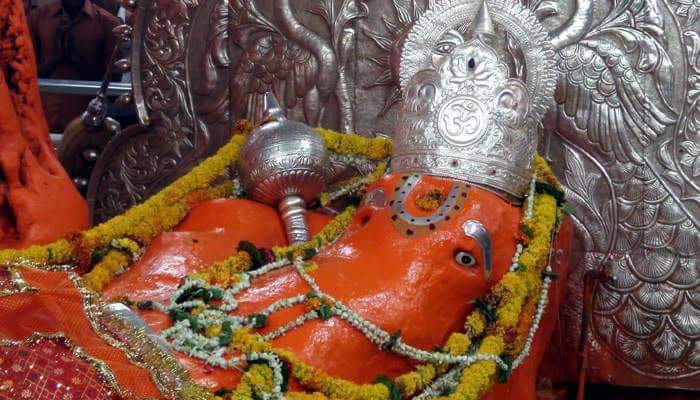
Hanuman Sadhna: Why does it matter?

HANUMAN VEERA BHAVA

Worshipped by millions across the globe for strength and endurance, ‘Bajrangi’ is actually a distorted version of ‘Vajra Anga’. Hanuman, whose body is as strong as thunder (vajra), is one of Rudra’s Avatars who is revered as the greatest devotee of the Vishnu avatar Sri Ramachandra. Born as a vanara swaroop, Anjaneya, as He is also known, once went to consume the mighty Surya for He thought it was a fruit dangling from the sky. It was there in the sky that Indra, the chief of gods, had used his vajra which threw Anjaneya back to the Earth, damaging his jaw forever. Henceforth He came to be known as Hanuman (‘Hanu’ meaning Jaw and ‘Man’ meaning Disfigured)

Seeing the prowess of the kid, Surya Narayan accepted Him as His shishya and imparted to Him the knowledge of the Vedas. Being the Lord of the solar system, Surya Narayan also taught Hanuman the nuances of the grahas and it is for this very reason why Hanuman is regarded as the must-worship-deity for all kinds of graha related afflictions, specially for problems caused by the two most feared grahas: Mangal (Mars) and Shani (Saturn). It is believed that His gada or mace prevents keeps Mangal away from afflicting your horoscope while His tail binds Shani from mangling your life.

Mangal, the karaka for Mrtyu or death is famed to destroy whichever house He sits in a person’s horoscope. The most dreaded Mangal dosha is infamous for causing either death of the spouse or a marital breakdown. In either case, people having Mangal dosha in their kundali are often seen to run from pillar to post in search of a nivaran for the dosha, often spending millions on rituals and gemstones that do not really work. A simple remedy would be to worship Hanuman on Tuesday mornings by lighting a ghee diya while sitting on an asana facing East and reciting the Hanuman Chalisa for 21 times and then fasting for the entire duration of the day without consuming food or liquids including water. The ritual should be repeated for 21 consecutive Tuesdays.

A name of Shani Maharaj in His Ashtottari Shatnamavali goes as ‘Jyestha Patni Sametaya’. Jyestha, who is regarded as the consort of Shani, is known to cause maladies between husband and wife. Of course, this is not the only way how Shani ferments trouble in the lives of people. As such, Hanuman can also be invoked to bring relief from troubles related to Shani. On a Saturday evening, sit on a black or blue woollen mat facing East and light a ghee diya. Recite the Hanuman chalisa 21 times and do the same for 21 consecutive Saturdays.

Hanuman also provides great relief during Saturn’s seven and half year time period which is more commonly known as the dreaded Sade Sati. This is a time when Shani Maharaj transits over your natal moon, thus bringing in untold misery and suffering in your life. For those undergoing their Sade Sati, every day during morning or evening one must sit on a mat or any asana facing East and light a ghee diya while also offering some dry chickpeas as prasad to Hanuman. Thereafter one must recite the Hanuman Chalisa for 7 times in one go and repeat the same every single day while running their Sade Sati. This is one underrated remedy which brings in immense benefits if done on a regular basis. Another remedy which is really powerful for Saturn based afflictions is to take a Hanuman vigraha and bathe it with a paste of turmeric (haldi) and thereafter apply a paste of orange vermilion (sindur) on it. This should be done every Saturday morning before 9am and continued for 40 Saturdays.

Hanuman also provides relief from distress caused by spirits and other disembodied beings. If one ever feels troubled by spirits and apparitions, one should keep a idol or picture of Hanuman within the house and read the Hanuman chalisa while sitting in front of the idol or picture every day for 7 times on the go. One should also visit a Hanuman temple and get some sindur from the left foot of the vigraha of Hanuman on an iron nail. Thereafter the nail should be driven into the main door of the house to prevent further disturbances by malevolent spirits and similar beings. Of course, such remedies are debatable but it is much better to do upayas which do not cost a dime rather than spending millions in the name of charlatans and tantrikas and black magicians.

The reason why Hanuman works so quickly on your problems is because He is very quickly accessible unlike other deities. Being Pawan Putra or the son of Vayu (the air element in your body), He is closer to you than your breath and hence starts working on fixing your life your right away. In fact, one does not even have to recite the Hanuman Chalisa to experience the grace. By simply uttering the name of Shri Rama in a loop (as in rAmArAmArAmA…), one can easily access this mighty deity who changes your life in the most unimaginable ways. This is because Hanuman has made a promise to Bhagwan Ramchandra to help anyone and everyone who chants Rama’s name with utmost devotion and sincerity.

May the grace of Anjaneya illuminate our miserable human existence and take us closer to the Divine.

Sankat Kate Mitey Sab Peeda
Jo Sumire Hanumat Balbeera.

Jai Shri Rama.


About the Author:

Devarshi Dutta is a mathematician and computer engineer by qualification with keen interest in Jyotisha (Vedic Astrology) and the occult sciences, especially dark magic and demonology.

He has authored books on Vedic Philosophy which include an acclaimed reference guide to ‘Dus Mahavidya Sadhana’. The books are available on Amazon as both paperback and kindle versions across all Amazon marketplaces.

Connect on Facebook: https://m.facebook.com/profile.php?id=100006339484794&ref=content_filter

ON LOVE AND ATTACHMENT

Attachment is egoism in love.”

This is how Sri Aurobindo once defined attachment (The Synthesis of Yoga, CWSA , Vol.23, p. 329). Perfect definition, if we deeply, seriously and sincerely think about it.
Attachment, egoism and love — these three have an intimate connection. Let us start with the most immediate, the first circle of our love – love for the family. We are attached to our families and we think it is love. It may be something like love, but it is not really Love. At best, it is a rehearsal ground for us to practice love.


Sometime back I probably couldn’t have said it this confidently, maybe because back then I had only read some wonderful words about love and ego and attachment and had not really experienced some of the truth of those words, had not really felt the intensity of the force of those words. But life has its own ways of making us sit up and learn some important lessons, for real, by making us live the truth of things. Today after going through some life-experiences over the past several years, I have realized how difficult it is to truly love.


Our minds refuse to accept the truth of the statement “attachment is egoism in love” and our hearts refuse to admit that what we ordinarily speak of as love may be nothing but an attachment because we have long forgotten what Yanjnavalkya said to Maitreyi thousands of years ago, about loving another person for the sake of the Self. Of course, we have forgotten the Self too, otherwise we wouldn’t be in this confused state regarding love, attachment and everything else. We have forgotten, and now only remain in love with ourselves, our ego-selves. And all the love that we say we feel for others is nothing but the love for our egos!


““Not for the sake of the wife,” says Yajnavalkya in the Upanishad, “but for the
sake of the Self is the wife dear to us.” This in the lower sense of the individual
self is the hard fact behind the coloured and passionate professions of egoistic
love; but in a higher sense it is the inner significance of that love too which is not
egoistic but divine.”
(Sri Aurobindo, CWSA, Vol. 23, p. 107)


According to the Mother (the spiritual collaborator of Sri Aurobindo), human love is not a need of the soul, “but rather a concession it makes for a time to the ego.” (CWM, Vol. 14, p.120). It may sound startling, even disturbing, to our ordinary intelligence, given that our rudimentary ideas about love are almost entirely shaped by what our popular culture and popular romantic literature and films tell us about it. Most of the times such unfiltered exposure to a variety of influences, most of which are not necessarily educative but rather meant to stimulate the lower nature of the individual – instincts, passion, and sensations, can end up creating more confusing and muddled understanding of love and loving. Perhaps this is why we throw the word ‘soulmate’ so casually, without even realizing that we don’t know what is this thing called soul! It is perhaps the false soul of desire in us which creates this illusion.


Love is a thing of the heart, people say. In ordinary parlance, what people generally refer to as the heart is simply an emotive heart, full of emotions more or less similar to the animal’s,but more variously developed, says Sri Aurobindo. [Yes, let us read that phrase again –“similar to animal’s”.]


“Its emotions are governed by egoistic passion, blind instinctive affections and all
the play of the life-impulses with their imperfections, perversions, often sordid
degradations, — a heart besieged and given over to the lusts, desires, wraths,
intense or fierce demands or little greeds and mean pettinesses of an obscure and
fallen life force and debased by its slavery to any and every impulse. This mixture
of the emotive heart and the sensational hungering vital creates in man a false
soul of desire…”
(CWSA, Vol. 23, p. 150)


This false soul of desire colours the movement of love with its petty instincts of clinging to its object of desire, which it sees as its object of love. And when there is desire, there is bound to be expectation; in this instance, expectation of being loved in return for loving the other. This is often the beginning of much degradation in love. The degradation continues with the insistence of the vital ego to possess the object of love entirely for its sake. With possession comes attachment, because why would I ever want to lose something for which I have craved so long! And the fall continues….


But why does it happen like this? The answer again lies in our ignorance. For the most part we are ignorant of the truth that ego is an instrument of nature which gives us a sense of separate existence. It is this separate existence in us, this individuality in us that seeks its own separate love, exclusively for itself. This love is coloured by all the different forms in which ego expresses itself, which may be understood as egoism.


Let us first be clear that because ego is essentially a separative instrument, it therefore
naturally becomes a hindrance when we try to connect with another individual, in any
relation. This is why there must be some control over the various tendencies through which ego imposes itself, otherwise life with others would be impossible. It has been observed that even among animals who live in groups, there are strict rules about imposing a control on the play of the ego.


We often hear and also say – that person is so egoistic, or she is so ego-centered. Some even go to the extent of saying – it is impossible to love that person because he or she is so egoistic! Okay, so the other person is egoistic and you are not! Such talk again comes from our deep ignorance of how ego and egoism work. As Sri Aurobindo reminds us –


“…the human being is naturally egoistic and ego-centred; all he does, thinks,
feels has the stamp of the ego on it…. Even when one tries to get away from it, it
is in front or walks behind all the thoughts and actions like one’s shadow”

(CWSA, Vol. 31, p. 218).

And as for this thing called egoism, we find a helpful and simple definition in the words of the Mother:

“When you want to pull everything towards you and other people do not interest
you, that is called egoism; when you put yourself at the centre of the universe and
all things exist only in relation to you, that is egoism. But it is very obvious, one
must be blind not to see that one is egoistic. Everybody is a little egoistic, more or
less, and at least a certain proportion of egoism is normally acceptable; but even
in ordinary life, when one is a little too egoistic, well, one receives knocks on the
nose, because, since everyone is egoistic, no one much likes egoism in others.”

(CWM, Vol. 3, pp. 240-241)


Selfishness, possession, attachment, vanity, ambition, pride, ingratitude, jealousy, envy,
wounded feeling and other such things are the various forms through which ego expresses itself. Through discipline, self-restraint and by becoming more and more conscious of the movements of this ego within us we can exercise greater control on the ego and become less and less egoistic.


With intense spiritual practice and a great aspiration, and of course, with the Divine Grace, as the inmost divine spark, the divine element in us slowly becomes a greater controller of our movements and responses, the hold of the ego is gradually loosened and we begin to experience greater inner freedom. All this has close connection with how we experience this thing called love.


“So long as the ego is there, one cannot love. Love alone can love, Love alone
can conquer the ego”
(The Mother, CWM, Vol. 14, p. 121).


It is a given that getting rid of ego is not an easy task for most of the humanity. All sages and seers have told us so. Even a saint may still have the sattvic ego, so what to say of ordinary folks like you and me! But perhaps something can be done about this thing called ‘egoism’.


And may be the first thing to do is to stop looking at our attachments as love. Because as long as we have attachments to others, we don’t really love; we can’t love another for the sake of loving, we love for the sake of the attachment. We love for this need to be loved in return, because the biggest attachment we have is to our little ego-self.


True love, says the Mother, is something very deep and calm in its intensity. It is not a
passion of the ordinary emotive heart, but a quality of the soul, an attribute of the real divine spark within. More importantly, true love finds its delight and satisfaction in itself. It does not need to manifest itself in any exterior ‘acts of love’, sensational or affectionate. It has no need to be received and appreciated, nor to be shared. It loves for the sake of loving, just the way a flower blooms. “To feel this love in oneself is to possess an immutable happiness,” says the Mother (CWM, Vol. 14, pp. 124-125).


Most human love is far removed from this true love. Most human beings in ordinary relations of love — regardless of the relation — speak of (or think of) their right to be loved. But love’s only right, if at all it has one, is the right of self-giving, says the Mother. Without self-giving there is no love.


An honest self-reflection and observation around us will tell us how rare is a true self-giving in human love, which is in actuality full of selfishness and demands. And yes of course, attachments!

So where is love?

Some truths take time to get accepted because of the deep ignorance in which we live our ordinary lives. Maybe it is one of those truths. As I said earlier, Life has its own ways of making us sit up and ponder deeply on our lives, loves and loving.


And while going through the various experiences and circumstances in life, it could also help us tremendously if we start contemplating on the nature of human love and relationships using a deeper psycho-spiritual view of human nature, given to us by the great yogis and rishis. These seers and sages have not only explored the depths of human nature but have also raised themselves to the highest heights of consciousness. No human experience is insignificant in their wider view of life and existence. And that’s why we are able to find relevant insights on almost all aspects of life in their writings and teachings.


About the Author:

Beloo Mehra is a student of Sri Aurobindo and writes on topics related to education, culture and society.

Many years of experience in the field of education and research led her to the discovery that the central thing is to constantly un-school oneself and become a freer and truer learner.

She enjoys playing several roles Life offers a woman – with a hope to learn from all that happens and doesn’t happen, and with a wish to gradually become free of those roles because only then the possibility of the birth of true actor (or the non-actor) within exists.

https://matriwords.com/

https://beautyishisfootprint.wordpress.com/